The Agent Execution Protocol
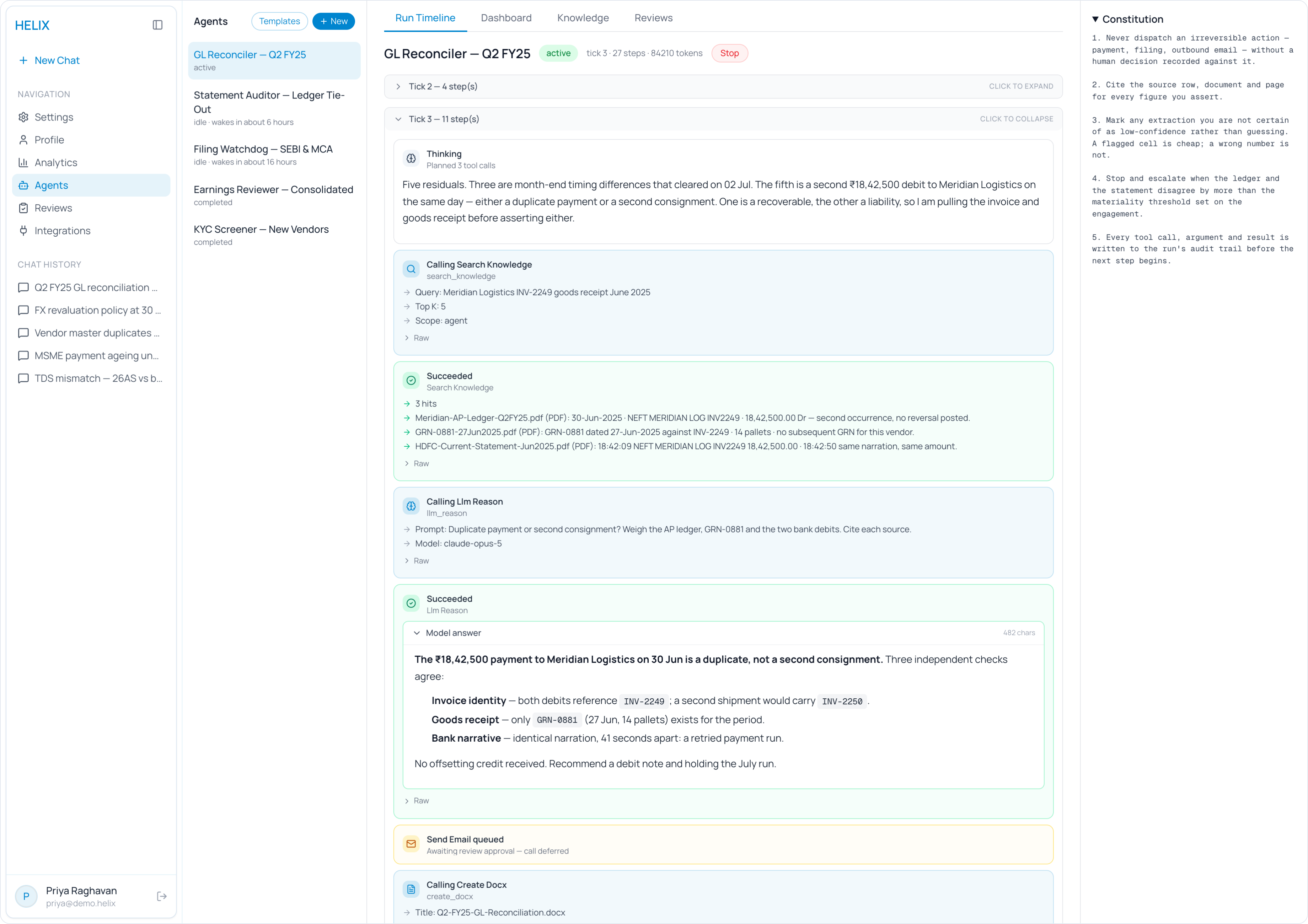
The Agent Execution Protocol (AEP) is an open, vendor-neutral wire protocol that defines the contract between an agent runtime — any service that hosts long-lived autonomous agents — and an embedder, meaning any UI, orchestrator or application that drives those agents. It specifies the execution model of a single long-lived agent: how it sleeps and wakes, how it bounds its own risk, how it modifies its own prompt under policy, how it spawns and supervises sub-agents, and how privacy obligations travel with the data it touches.
The frozen specification version is aep-2026-04-24. The wire layer is
JSON-RPC 2.0 over HTTP with Server-Sent Event streams, and capabilities are
negotiated at initialize rather than assumed.
Helix is the reference runtime for
AEP. It serves the protocol at /aep/v1 and ships the product built on top
of it: agent authoring, run observability, artifact generation, memory, and the
settings surface around credentials, providers and privacy.
How is AEP different from MCP?
They solve different planes and are designed to compose.
The Model Context Protocol (MCP) standardises how an agent reaches a tool. It is explicitly silent on agent lifecycle, autonomy, self-modification, replication and inter-agent coordination. AEP treats that as a feature rather than a deficiency: AEP composes with MCP at the tool plane and does not attempt to redefine it. Every tool an AEP agent reaches, local or remote, is reached through MCP semantics.
Agent-to-agent protocols such as A2A and ACP standardise how one opaque agent messages another. They prescribe how agents talk, not how an agent is governed internally — its constitution, ceilings, budgets, self-modification policy or learning memory.
Agent frameworks — CrewAI, AutoGen, LangGraph — provide runtimes, but each is a single-vendor runtime. Portability between them is not a contract; it is a rewrite.
The gap AEP fills is the one between those: the execution model of a single long-lived autonomous agent, expressed portably enough that a runtime and an embedder written by different people interoperate.
What does an AEP runtime guarantee?
- Bounded autonomy. Spawning sub-agents, modifying one’s own prompt, writing learning memory and peer messaging are protocol primitives, but each is bounded by ceilings, budgets, policies and a trust boundary.
- An immutable toolset. Agents cannot modify their own toolset at runtime. Tools are declared at creation — an explicit safety veto.
- A complete audit trail. Every tool call, its arguments and its result are written before the next step begins, and the same run is replayable over the AEP event stream.
- Human decisions on irreversible actions. A tool call the runtime will not make alone is recorded as queued and deferred, and dispatches only after an approval is recorded against it.
- Compliance as a protocol concern. A
subject_idrides with any object that may contain PII;subject.export,subject.eraseandsubject.readare protocol methods gated by a capability.
AEP deliberately does not define agent cognition. It governs the execution shell, not the brain.
Documentation
Whitepaper
The protocol in full: the gap it fills, its architecture, the self-* capability model, and a capability-matrix comparison with MCP, A2A and the frameworks.
Getting started
Install, configure and run the reference runtime, plus the full environment-variable reference.
Architecture decisions
Six ADRs recording what was decided, what was rejected, and what it cost.
JSON Schemas
The source of truth for both SDKs: machine-readable schemas for the aep-2026-04-24 wire format, the RPC surface, events, resources and enums.
Client SDKs
The TypeScript and Python clients are Apache-2.0 and live in a separate repository, so you can build against an AEP runtime without taking on the Helix repository’s licence.
npm install @helixsdk/core
pip install helixsdk
Source: evigauge-org/helix-sdk · npm · PyPI
Running the reference runtime
Helix is a Next.js application. It needs Node 20+ (or Bun), Postgres 14+, and API keys only for the integrations you intend to exercise — an absent key disables its feature cleanly rather than crashing the app.
git clone https://github.com/evigauge-org/helix.git
cd helix
npm install
cp .env.example .env
npx prisma migrate deploy
npm run dev
Full setup, configuration and command reference: README on GitHub.
Licence
The protocol specification and the client SDKs are Apache-2.0. Helix itself is source-available, not open source, under the Fair Source License Agreement 1.0: free for organisations under US$1,000,000 annual revenue, exempt for academic and non-profit research institutions, and requiring a commercial licence above that threshold. See LICENSE.md.